Description of services
When you book a routine dental for your horse, what is it you are getting?
Why does a horse need checking at all? Well for a start, a horse needs to do a lot of eating, so those teeth get an awful lot of use throughout a horse's life and so problems inevitably develop. However a horse's teeth differ from ours in that they are constantly wearing away at the surface, whilst erupting out of the skull throughout their life. This means that any slight imbalance can develop into sharp overgrowths that worsen month-by-month.
The routine dental examination and rasp is the basic check-up that is essential for maintaining a comfortable and effective mouth in your horse. I usually recommend healthy horses with no known dental issues get checked at least once a year. Those horses with known issues, younger or older horses may need checking more frequently than this.
Firstly the horse will be sedated. This not only hugely reduces the stress of the procedure for the horse, but it is the only way to ensure that a truly thorough dental examination can be performed in maximum safety for the horse. Once the horse is relaxed, I will start by feeling the head and face for any abnormalities; I will inspect the incisors, before fitting the dental speculum and beginning the detailed examination of the inside of the mouth.
After thoroughly cleaning the mouth, dental lights and mirrors will be used to inspect every surface of every tooth, as well as the tissues around them. I will look for, amongst other things, enamel overgrowths and points, excessive ridging and areas of imbalance in the tooth arcades, tooth fractures and subtle signs of tooth infection, dental caries and problems of the gums and spaces between the teeth.
The routine rasp will then aim to remove any sharp enamel points, balance the arcades and reduce any minor occlusal overgrowths. This is done with a variety of powered dental tools, each one specialised to work in different areas of the mouth and with different mouth shapes.
Finally, you will get a digital dental chart that explains the work done and any recommendations for the future, as well as organising a reminder for the next check up date.
The price of a routine dental is detailed below. Any non-routine work that is necessary or recommended will be explained to you at the time of the examination. Discounts apply for multiple horses seen on the same visit. A standard sedation dose is included in the cost and an additional visit fee will apply that will depend upon your location.
1 horse - £90
2-4 horses - £85/horse
5+ horses - £75/horse
The Routine Dental
Other routine veterinary dental services
Other common dental procedures are performed on a routine basis. These include young horse dental procedures like the extraction of wolf-teeth (small, vestigial teeth that can sit in the way of the bit) or the removal of loose deciduous teeth or “caps”.
Advanced procedures
Being told that your horse needs additional dental work can be worrying - it is often not something you can see yourself and so can be a mystery. Here I shall try to explain a few procedures so that if your horse needs advanced work, you can get an idea of what is involved.
Diastema and Periodontal Treatment
A diastema in a horse is a gap between two teeth that shouldn't be there. They are problematic because food becomes entrapped within them, damaging the gum and ligaments that hold the tooth in place with the bacteria fermenting the rotting food. It is known to be a highly painful condition and causes loss of condition, problems ridden, choke and can contribute to colic. It often also leads to tooth loss. The most often noted sign by the owner is “quidding”, or the spitting out of balled-up, improperly-chewed forage.
Diastemata are treatable, with the success of treatment depending on how quickly the problem is dealt with, the cause of the diastema and the quality of dental treatment afterwards. Treatments generally include a combination of rasping and reshaping of teeth, high-pressure flushing, diastema widening (where the space is drilled open to prevent food entrapment), bridging of spaces and, sometimes tooth removal.
The procedures are all done with the horse standing and sedated. Sometimes numbing of the areas to be treated is necessary as it is such a painful condition. The horse will often also be given a short course of pain-relief after the treatment to encourage it to get straight back to healthy eating.
Infundibular restoration/fillings
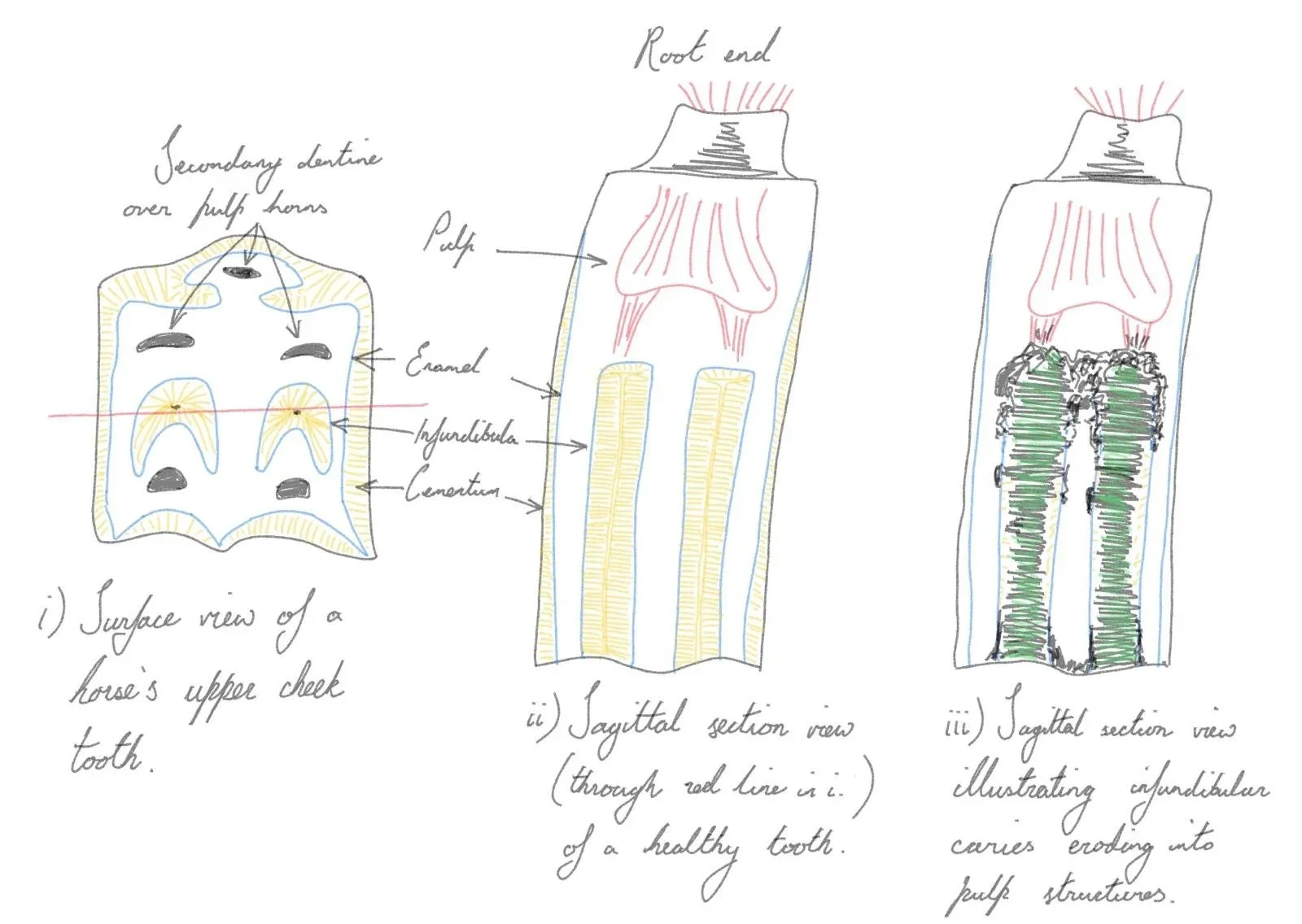
The option of fillings is a new idea for many horse owners, but it is a development that can help prevent a host of problems that, thanks to new techniques and knowledge, was never an option in times past.
Whereas previously we only had the option of removing diseased teeth once they became infected or broken, we are now able to prevent this in many cases with fillings, similar to in our own teeth. A specific condition termed “infundibular hypoplasia and caries” will progress in many cases to cause tooth root infection and/or tooth fracture, but we can act to prevent this by restoring the decayed holes with fillings, maximising the healthy lifespan of your horse's teeth.
When performing this technique, the horse is standing and sedated and the diseased, decayed area is carefully and finely drilled out using dental drills and burrs, then a permanent filling is placed within the cavity. Unlike humans, this cavity is often several cm deep, but should last the normal lifespan of the tooth, preventing further decay, infection and fracture of the tooth.
Tooth extraction
Deciding to extract a tooth in a horse is never a decision to be taken lightly. The mission of a good equine dental technician should be to ensure a comfortable, functional mouth for as long as possible in the horse's life. So removing a tooth is something we should only do if we have to, in order to preserve other teeth, prevent more widespread infection, or make the horse more comfortable.
The vast majority of tooth extractions are done with the horse stood and sedated. First the area of the tooth extraction is numbed so that it will not feel the procedure. Then the type of tooth extraction performed will depend upon the state of the tooth. Wherever possible, we will attempt to remove the tooth via the mouth by loosening it and grasping it with long-handled tools. This is the most common method and is successful in most cases.
Sometimes this method is not possible however, either because the tooth is too fractured to be grasped from the mouth, or because an abnormally shaped tooth means it will not come out via the normal method. These cases may be accessed surgically, often by a “keyhole” approach through the cheek.
Once the tooth is removed, the socket will be plugged to prevent it filling with food. 2 or 3 recheck appointments are usually necessary over the weeks following the procedure and most cases are back to being exercised within 2-4 weeks.